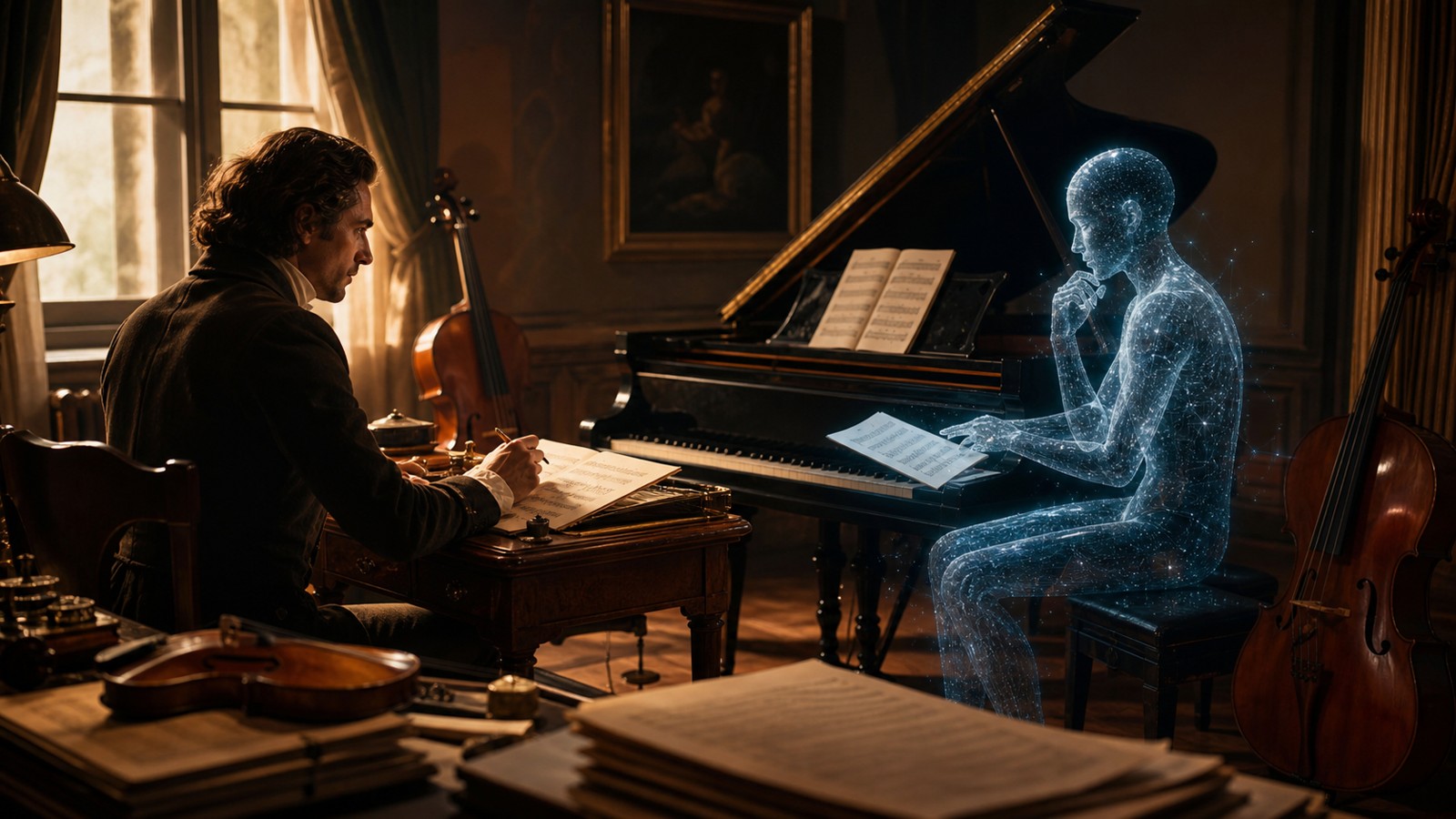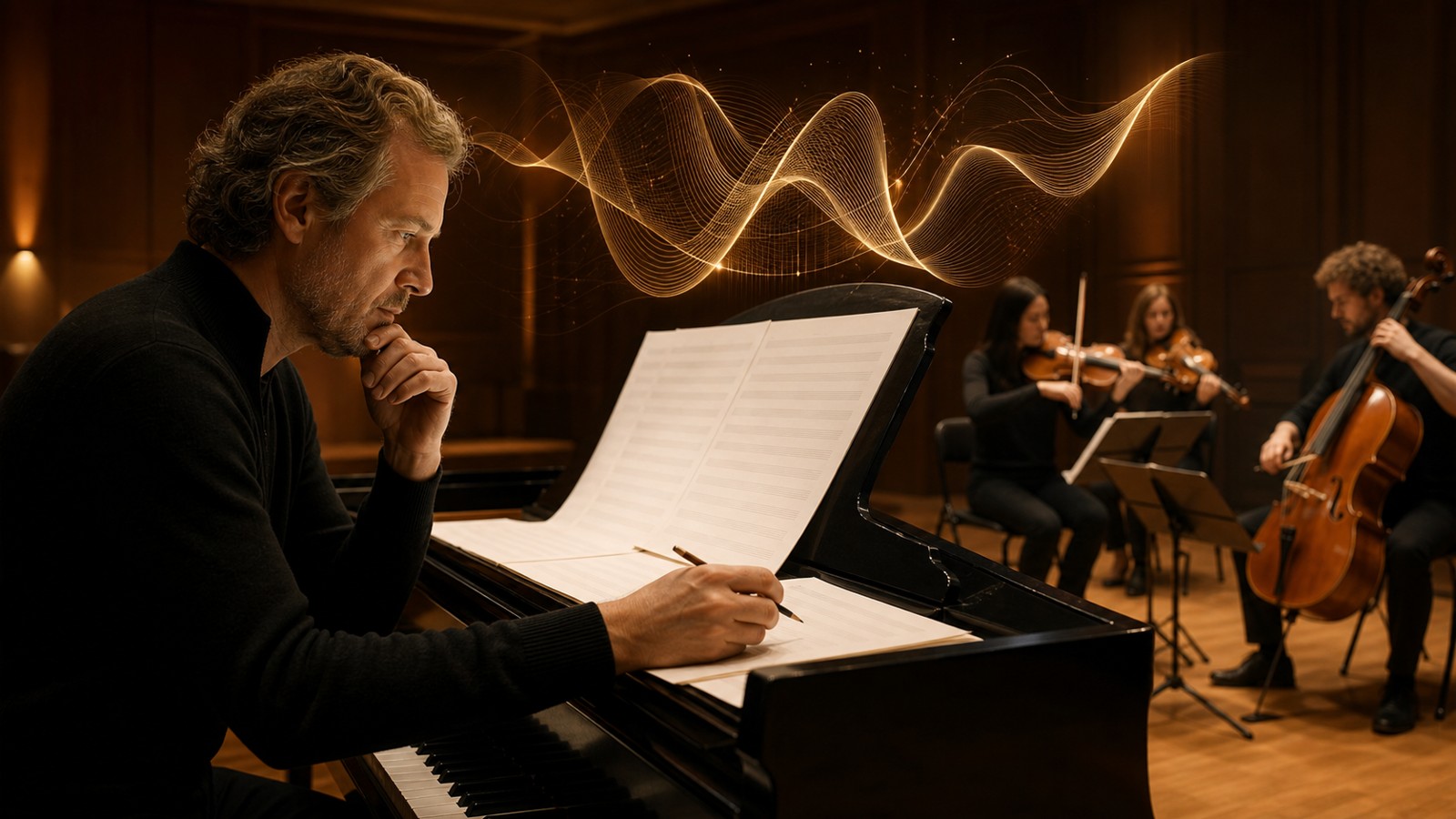
This guide looks closely at AI inside the old discipline of composition and orchestration. Instead of treating AI as a generic music shortcut, it focuses on the specific pressures facing composers, students, arrangers, and conductors. The question is not simply whether software can produce something that resembles a track. The harder question is what happens to judgment, credit, performance, and musical identity when motifs, counterpoint, strings, piano reductions, rehearsal notes become easier to generate, revise, and circulate. The question is not simply whether software can produce something that resembles a track. The harder question is what happens to judgment, credit, performance, and musical identity when motifs, counterpoint, strings, piano reductions, rehearsal notes become easier to generate, revise, and circulate.
The Composer’s Desk Is Changing
A better workflow is slower at the point of judgment. Generate quickly if that helps, but listen again away from the tool. Ask what the section is doing, whose knowledge it depends on, and whether the final result could only belong to this project. That is how AI inside the old discipline of composition and orchestration keeps its shape while still benefiting from new technology.
The Composer’s Desk Is Changing matters because AI inside the old discipline of composition and orchestration depends on more than technical output. The surface can be generated quickly, but the meaning comes from how composers, students, arrangers, and conductors choose, cut, repeat, perform, or reject what appears. When AI touches motifs, counterpoint, strings, piano reductions, rehearsal notes, it can speed up the search for options while also making weak ideas look more finished than they really are.
In practice, the composer’s desk is changing is where the work becomes concrete. A tool may produce something convincing on first playback, but composers, students, arrangers, and conductors still have to ask whether it survives the room, the body, the listener, and the larger tradition around it. The answer often appears in small details: timing, restraint, tone, credit, or the decision to leave something imperfect.
Drafts Are Faster Than Decisions
In practice, drafts are faster than decisions is where the work becomes concrete. A tool may produce something convincing on first playback, but composers, students, arrangers, and conductors still have to ask whether it survives the room, the body, the listener, and the larger tradition around it. The answer often appears in small details: timing, restraint, tone, credit, or the decision to leave something imperfect.
Orchestration Is More Searchable
The danger is not that every machine-made result is useless. The danger is that motifs, counterpoint, strings, piano reductions, rehearsal notes can become interchangeable when the same shortcuts are accepted without pressure. Good use of AI starts when composers, students, arrangers, and conductors treat the output as material to argue with, not as a finished verdict.
A better workflow is slower at the point of judgment. Generate quickly if that helps, but listen again away from the tool. Ask what the section is doing, whose knowledge it depends on, and whether the final result could only belong to this project. That is how AI inside the old discipline of composition and orchestration keeps its shape while still benefiting from new technology.
Why Development Still Matters
Why Development Still Matters matters because AI inside the old discipline of composition and orchestration depends on more than technical output. The surface can be generated quickly, but the meaning comes from how composers, students, arrangers, and conductors choose, cut, repeat, perform, or reject what appears. When AI touches motifs, counterpoint, strings, piano reductions, rehearsal notes, it can speed up the search for options while also making weak ideas look more finished than they really are.
In practice, why development still matters is where the work becomes concrete. A tool may produce something convincing on first playback, but composers, students, arrangers, and conductors still have to ask whether it survives the room, the body, the listener, and the larger tradition around it. The answer often appears in small details: timing, restraint, tone, credit, or the decision to leave something imperfect.
The danger is not that every machine-made result is useless. The danger is that motifs, counterpoint, strings, piano reductions, rehearsal notes can become interchangeable when the same shortcuts are accepted without pressure. Good use of AI starts when composers, students, arrangers, and conductors treat the output as material to argue with, not as a finished verdict.
Students Can Hear More Examples
A better workflow is slower at the point of judgment. Generate quickly if that helps, but listen again away from the tool. Ask what the section is doing, whose knowledge it depends on, and whether the final result could only belong to this project. That is how AI inside the old discipline of composition and orchestration keeps its shape while still benefiting from new technology.
Conductors Need Playable Scores
Conductors Need Playable Scores matters because AI inside the old discipline of composition and orchestration depends on more than technical output. The surface can be generated quickly, but the meaning comes from how composers, students, arrangers, and conductors choose, cut, repeat, perform, or reject what appears. When AI touches motifs, counterpoint, strings, piano reductions, rehearsal notes, it can speed up the search for options while also making weak ideas look more finished than they really are.
In practice, conductors need playable scores is where the work becomes concrete. A tool may produce something convincing on first playback, but composers, students, arrangers, and conductors still have to ask whether it survives the room, the body, the listener, and the larger tradition around it. The answer often appears in small details: timing, restraint, tone, credit, or the decision to leave something imperfect.
Tradition Is a Constraint, Not a Cage
A better workflow is slower at the point of judgment. Generate quickly if that helps, but listen again away from the tool. Ask what the section is doing, whose knowledge it depends on, and whether the final result could only belong to this project. That is how AI inside the old discipline of composition and orchestration keeps its shape while still benefiting from new technology. Tradition Is a Constraint, Not a Cage matters because AI inside the old discipline of composition and orchestration depends on more than technical output. The surface can be generated quickly, but the meaning comes from how composers, students, arrangers, and conductors choose, cut, repeat, perform, or reject what appears. When AI touches motifs, counterpoint, strings, piano reductions, rehearsal notes, it can speed up the search for options while also making weak ideas look more finished than they really are.
The Future of Human Intention
The Future of Human Intention matters because AI inside the old discipline of composition and orchestration depends on more than technical output. The surface can be generated quickly, but the meaning comes from how composers, students, arrangers, and conductors choose, cut, repeat, perform, or reject what appears. When AI touches motifs, counterpoint, strings, piano reductions, rehearsal notes, it can speed up the search for options while also making weak ideas look more finished than they really are.
In practice, the future of human intention is where the work becomes concrete. A tool may produce something convincing on first playback, but composers, students, arrangers, and conductors still have to ask whether it survives the room, the body, the listener, and the larger tradition around it.
The answer often appears in small details: timing, restraint, tone, credit, or the decision to leave something imperfect.
What to Listen For
Listeners should pay attention to whether the work carries a point of view after the novelty fades. In AI inside the old discipline of composition and orchestration, the most revealing moments are often not the loudest or cleanest ones. They are the moments where a human decision can be heard: a pause, a rough edge, a credited source, a playable phrase, or a refusal to make the obvious move.
If the music only proves that motifs, counterpoint, strings, piano reductions, rehearsal notes can be imitated, it will age quickly. If it uses AI to clarify a stronger idea, it has a better chance of feeling durable.
Why This Angle Changes the Outcome 10
The same AI feature can be helpful or harmful depending on the goal. For composers, students, arrangers, and conductors, a fast draft is useful when it opens choices, but it becomes a problem when it hides authorship or turns motifs, counterpoint, strings, piano reductions, rehearsal notes into a generic surface. That distinction is why this topic needs its own treatment rather than the same broad AI-music explanation. Good creative practice leaves a trail of decisions. It should be possible to explain what was generated, what was changed, what was rejected, and why the finished piece deserves to exist in this form.
Why This Angle Changes the Outcome 11
The same AI feature can be helpful or harmful depending on the goal. For composers, students, arrangers, and conductors, a fast draft is useful when it opens choices, but it becomes a problem when it hides authorship or turns motifs, counterpoint, strings, piano reductions, rehearsal notes into a generic surface. That distinction is why this topic needs its own treatment rather than the same broad AI-music explanation.
Good creative practice leaves a trail of decisions. It should be possible to explain what was generated, what was changed, what was rejected, and why the finished piece deserves to exist in this form.
Why This Angle Changes the Outcome 12
The same AI feature can be helpful or harmful depending on the goal. For composers, students, arrangers, and conductors, a fast draft is useful when it opens choices, but it becomes a problem when it hides authorship or turns motifs, counterpoint, strings, piano reductions, rehearsal notes into a generic surface. That distinction is why this topic needs its own treatment rather than the same broad AI-music explanation. Good creative practice leaves a trail of decisions. It should be possible to explain what was generated, what was changed, what was rejected, and why the finished piece deserves to exist in this form.
Why This Angle Changes the Outcome 13
The same AI feature can be helpful or harmful depending on the goal. For composers, students, arrangers, and conductors, a fast draft is useful when it opens choices, but it becomes a problem when it hides authorship or turns motifs, counterpoint, strings, piano reductions, rehearsal notes into a generic surface. That distinction is why this topic needs its own treatment rather than the same broad AI-music explanation.
Good creative practice leaves a trail of decisions. It should be possible to explain what was generated, what was changed, what was rejected, and why the finished piece deserves to exist in this form.
Why This Angle Changes the Outcome 14
The same AI feature can be helpful or harmful depending on the goal. For composers, students, arrangers, and conductors, a fast draft is useful when it opens choices, but it becomes a problem when it hides authorship or turns motifs, counterpoint, strings, piano reductions, rehearsal notes into a generic surface. That distinction is why this topic needs its own treatment rather than the same broad AI-music explanation. Good creative practice leaves a trail of decisions. It should be possible to explain what was generated, what was changed, what was rejected, and why the finished piece deserves to exist in this form.
Final Takeaway
The future here is not a simple replacement story. AI will remove friction from parts of the process, and some low-context work will become easier to automate. But composers, students, arrangers, and conductors still define the values around the music. The best results will come from creators who use faster tools without surrendering the slower responsibilities of taste, consent, and meaning.