

AI Jazz & Blues is where timeless soul meets cutting-edge code. This space on AI Music Street explores how artificial intelligence is reimagining two of the most expressive genres ever created—without losing the grit, swing, and emotion that make them unforgettable. From smoky blues progressions and late-night jazz harmonies to improvisational solos shaped by algorithms, AI is opening new creative doors for musicians, producers, and curious listeners alike. Here you’ll discover how machine learning models study phrasing, rhythm, and feel, then generate melodies that echo the warmth of a vintage club or the raw honesty of a delta blues session. Some artists use AI as a collaborative bandmate, others as a compositional sketchpad, and some as a way to resurrect forgotten styles with a modern twist. This category dives into tools, techniques, and experiments that blend human intuition with digital intelligence. Whether you’re a jazz purist exploring AI-assisted improvisation, a blues songwriter searching for fresh inspiration, or simply fascinated by where music is heading next, AI Jazz & Blues invites you to listen closer, think deeper, and feel the future swing.
A: Specify swing feel, ride pattern, and slight behind-the-beat phrasing; avoid quantizing everything.
A: A clean 12-bar map with your turnaround (I–VI–II–V or I–♭VII–IV–I) gives reliable structure.
A: Ask for motif development, chord-tone anchors on strong beats, and “repeat then vary” across choruses.
A: Yes—prompt for quarter-note motion, voice-leading, chromatic approaches, and occasional rhythmic pushes.
A: Add rules: “leave 1–2 beats of rest per bar,” “answer phrases,” and “don’t fill during vocals.”
A: Key, tempo, form, chord chart (or Roman numerals), and whether to use extensions/substitutions.
A: Use articulation prompts (falls, scoops, bends), plus automation for dynamics and tone across sections.
A: Timing first (tiny), then velocity; too much velocity randomization can sound chaotic in swing.
A: Use subtle room reverb, natural stereo placement, and keep dynamics—don’t squash with heavy limiting.
A: Generate a short head + 1 chorus solo, refine groove, then expand arrangement once the pocket is locked.
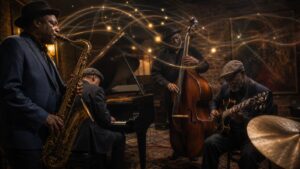
How AI Is Transforming Jazz and Blues Music Forever
A focused explainer on living traditions, improvisation, and machine study, written for jazz players, blues musicians, teachers, and producers, with attention to creative choices, risks, credits, and musical identity.

AI Jazz Explained: Can Machines Truly Improvise?
A focused explainer on improvisation as conversation rather than note choice, written for improvisers, teachers, ensemble leaders, and jazz listeners, with attention to creative choices, risks, credits, and musical identity.

The Rise of AI Blues: Can Algorithms Feel the Music?
A focused explainer on blues feeling, timing, and cultural weight, written for blues guitarists, singers, historians, and producers, with attention to creative choices, risks, credits, and musical identity.